

ADHD and Sleep: Why It’s Not Just About Sleep Hygiene
If you’re reading this, you probably already know the basics of “good sleep.” (And if you want a refresher, I’ve written about that here.)
But if you have an ADHD or AuDHD brain, you may have noticed something frustrating:
no amount of chamomile tea or horlicks, screen-time bans or perfectly timed routines quite solves the challenges.
That’s because, for many neurodivergent adults, sleep isn’t really a routine problem.
It’s a regulation issue...and misunderstanding that difference is often why so many capable, thoughtful people feel quietly stuck.
1. The cost of coping
For many adults with ADHD, sleep doesn’t just look “a bit off.” It often feels completely out of sync with how life is supposed to work.
Many individuals are able to meet external demands such as holding down jobs, managing responsibilities and keeping things moving, but often with significant internal effort.
From the outside, it can look like they’re coping well...but underneath, there’s often a cost.
Many people describe getting through the day on effort alone… then crashing the moment they get home. Evenings become recovery. Weekends become catch-up.
Yet, when it’s finally time to sleep, something shifts.
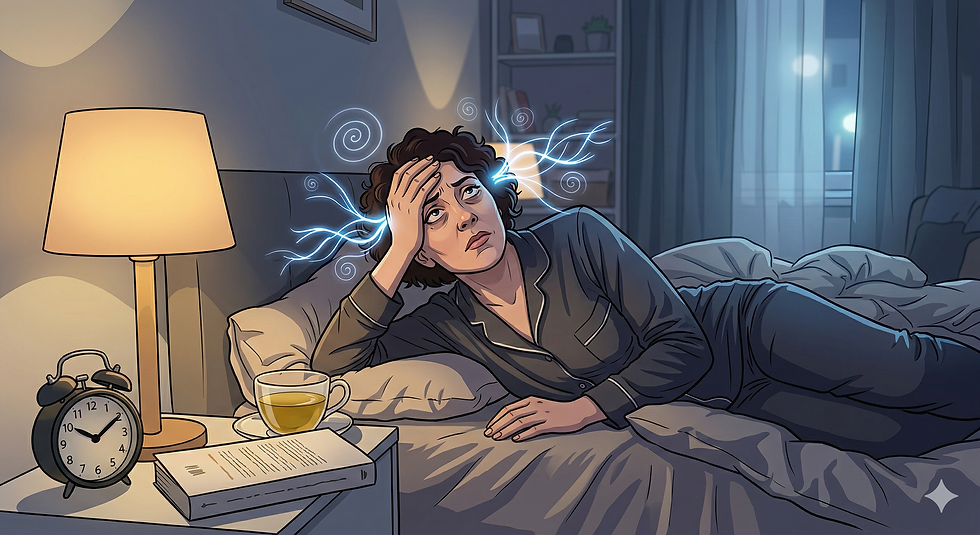
Instead of switching off, your mind wakes up. You get a second wind. You feel exhausted but not settled.
It’s that familiar experience of being tired, but wired.
And it doesn’t just affect how you feel, it can impact how quickly you process information, how easily you shift attention and how regulated you feel emotionally the next day.
2. Sleep as a regulation issue
To make sense of this, it helps to look beyond habits and into how the system is functioning.
It’s understood that a large proportion of adults with ADHD experience a shift in their sleep–wake patterns, often feeling more alert later in the evening and more tired during the day, almost as if their internal clock is slightly out of sync with the world around them.
ADHD is often described as a disorder of attention but in practice, it’s better understood as a difficulty with regulation across attention, emotion and energy.
That includes how we shift between being ‘on’ and being able to switch 'off'.
One part that often gets overlooked is that falling asleep is, in itself, a kind of transition task.
It requires the brain to disengage from whatever it’s focused on, step away from stimulation and move into a completely different state.
For many people with ADHD, that “switch” isn’t as smooth as it sounds.
So the experience of “just one more episode” or “I’ll go to bed in a minute” isn’t simply about willpower; it reflects how difficult it can be to step away from something engaging once your attention is locked in.
There’s also a neurochemical layer to this.
Dopamine plays a role in regulating alertness and the sleep–wake cycle. When that system is less stable, the transition between being awake and being ready to sleep can feel less predictable (almost as if the “off switch” doesn’t engage in the way you’d expect).
Alongside this, many people with ADHD experience a form of internal restlessness, where the system feels slightly “on,” even when there’s no obvious reason for it.
So instead of gradually winding down into sleep, the system often stays active until it hits a point of exhaustion.
You may not feel ready to sleep at a conventional time, but find your focus improving later in the evening. By the time your brain is ready to wind down, life still expects you to wake early.
Over time, that mismatch builds up and not because you’re doing anything wrong, but because your internal timing and the external world aren’t aligned.
3. Stress, pressure and the cost of coping
Because of these differences, many adults with ADHD end up relying (often unconsciously) on pressure to function.
Deadlines, urgency, last-minute pushes. Not because they want to… but because it works. At least in the short term.
But there’s a cost.
Instead of moving between effort and recovery, the system can become more consistently activated. You get used to running on stress and when that becomes the baseline, sleep doesn’t just require rest, it requires down-regulation.
This is where people often get stuck.
You can do all the “right” things such as reduce screens, follow a routine, but if your body is still in a state of activation, sleep will remain difficult. For some people, even small things like a noise, a thought, a light or a sensation can become harder to ignore at night.
From this perspective, sleep becomes less about control and more about whether your system feels able to settle.
4. The loop that keeps it going
When sleep is framed as a habit problem, it’s easy to miss the cycle underneath it.
It often looks something like this:
Poor sleep → reduced executive function → more stress → even worse sleep
When you’re sleep deprived, things that were already effortful (the focus, task initiation, emotional regulation etc) become even harder.
Tasks build up. Pressure increases. There’s more to hold, with less capacity to hold it... So you push harder.
You rely on urgency, pressure and adrenaline to get through the day.
Which means that by the time you get to bed, your system is still activated, even if you’re exhausted.
And the cycle repeats.
5. Looking at sleep more closely
When you step back, sleep difficulties in ADHD rarely show up as just one issue. For many people, there are multiple layers at play.
Your sleep–wake rhythm may be shifted later than usual. You may struggle to fall asleep at a conventional time, but feel more alert in the evening.
This often means that by the time your brain feels ready to sleep, the rest of your life still requires you to wake early; leading to a gradual build-up of sleep debt.
There can also be patterns such as:
difficulty stopping what you’re doing at night (“just one more episode”)
difficulty falling asleep, even when tired
waking during the night
restless or disrupted sleep
feeling unrefreshed, even after enough hours in bed
There may also be other factors involved such as underlying sleep conditions, physical health factors or simply a long-standing pattern of disrupted rhythm.
6. Not all sleep problems are the same
One useful distinction is between insomnia and sleep deprivation; because they often get blurred together.
With insomnia, the opportunity to sleep is there but your system won’t switch off. You may lie awake, struggle to fall asleep, or wake during the night.
With sleep deprivation, the issue is different. You can sleep, but for various reasons, you’re not getting enough of it. You stay up later than intended, often because your brain is finally engaged or because it’s hard to stop what you’re doing.
In ADHD and AuDHD, both patterns can show up...and the difference matters.
Because over time, sleep deprivation tends to have a broader impact on physical health, energy and cognitive function, even if it feels more “in your control.”
What actually helps in practice
When this shows up in real life, the solution is rarely about “fixing sleep” directly.
It’s usually about making small adjustments to how the system is being used across the day.
In my experience (both personally and in coaching) a few patterns tend to make the biggest difference:
Creating a clearer “off-ramp” at the end of the day
not going straight from stimulation into bed, but allowing some form of transition
reducing reliance on last-minute pressure
even slightly shifting tasks earlier in the day can reduce that late-night second wind
working with your natural rhythm, not against it
not everyone will fit a perfect 9–5 and so small adjustments can go a long way
paying attention to energy, not just time
noticing (and capturing!) when your system is activated vs settled and adjusting accordingly
allowing genuine recovery (not just collapse)
building in moments of lower demand, rather than only stopping when exhausted
reducing the “late-night catch-up” cycle
where the evening becomes the only time you feel focused or in control
These aren’t rigid rules of course.
They’re ways of working with your system rather than against it.
Because for many people with ADHD and AuDHD, better sleep isn’t something you fix at night. It’s something you support across the day.
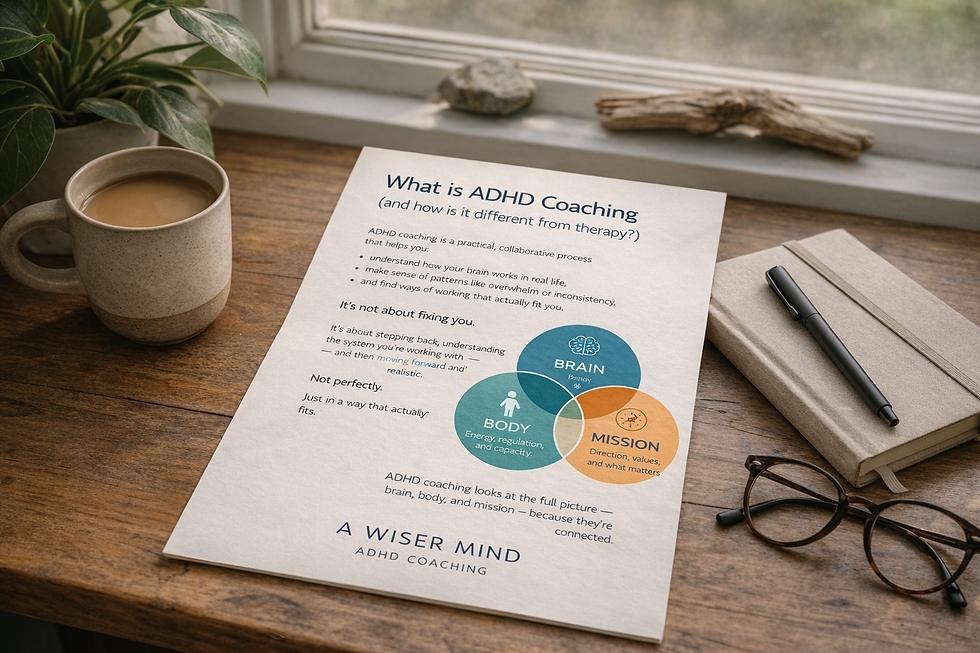
This is often the kind of work that comes up in coaching; not fixing sleep directly, but understanding the patterns around it.
The takeaway
If you’ve been struggling with sleep and feeling like you’re “failing” at the basics, it’s worth pausing here.
This isn’t about a lack of discipline.
For many people with ADHD or AuDHD, sleep difficulties reflect how the brain and body regulate energy, attention and stress; not a failure to follow the right routine.
Which means the solution isn’t just better habits in isolation.
It’s about understanding your system and making things slightly easier, rather than constantly pushing against it.
Note
This article reflects a combination of research, clinical perspectives, professional training and lived experience; both personally and through working with clients.


Comments