

What is ADHD Coaching (and how is it different from therapy)?
If you’ve come across ADHD coaching, you might be wondering what it actually is and whether it’s something that could help.
There’s a lot of noise in this space. Some of it helpful. Some of it confusing.
So rather than giving a formal definition, I want to explain how I understand and practice ADHD coaching; based on real work, professional training and experience.
A simple way to think about it
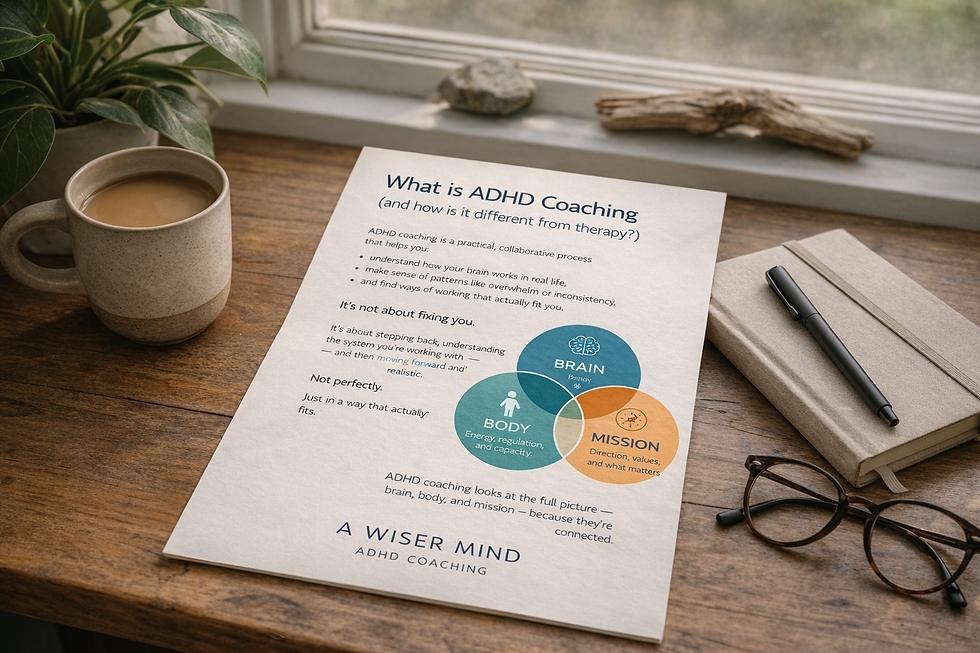
ADHD coaching is a practical, collaborative process that helps you:
understand how your brain works in real life
make sense of patterns like overwhelm, inconsistency or burnout
find ways of working that actually fit you
It’s not about fixing you.
It’s more about stepping back, understanding the system you’re working with and then moving forward in a way that’s realistic. Not perfectly; just in a way that actually fits.
A grounded definition (without overcomplicating it)
ADHD coaching is often described as a psycho-educational and solution-focused approach; helping people understand how ADHD affects daily life and develop strategies that work for them.
But in practice, it tends to look more like:
noticing patterns
testing small changes
understanding what works (and what doesn’t)
building something more sustainable over time
A key part of this is recognising that ADHD isn’t one fixed thing. Everyone has their own pattern and their own “map”. And coaching is really about learning how to navigate that.
How I approach ADHD coaching: Brain, Body & Mission
One way I make sense of this work is through three interacting areas:
🧠The Brain: How things actually show up
Things like:
starting
prioritising
following through
keeping things in mind
Not in theory, but in your day-to-day life.
🧍The Body: Capacity and regulation
This is often the missing piece.
A lot of what looks like a “focus problem” is actually:
low energy
overload
nervous system strain
So we look at:
energy, not just time
what your system can realistically handle
patterns of burnout, fatigue, or dysregulation
Because if the body isn’t in a place where it can engage, it’s very hard to access executive function in a meaningful way.
🎯The Mission: What you’re moving towards
Without this, even good strategies don’t hold.
So we explore:
what matters to you
what fits you
what you’re actually trying to build
These three are always interacting. And often, what looks like a problem with motivation or discipline is something else underneath.
What people actually bring to coaching
Most people don’t come saying:
“I want help with executive function.”
They say things like:
“I know what to do, but I can’t seem to do it consistently”
“I’m exhausted from trying to keep up”
“I feel capable, but something isn’t working”
A pattern I see a lot is:
people who are clearly capable, but things aren’t translating into consistent action.
That’s usually where the work starts.
Not by pushing harder but by understanding what’s going on.
What ADHD coaching focuses on
In simple terms, it often involves:
making things easier to start
reducing friction
building systems that are realistic
noticing patterns such as what works, what doesn’t and why
So that over time, change becomes more repeatable. Not perfect, just more workable.
What ADHD coaching is not
It’s not:
therapy
diagnosis
medical treatment
being told what to do
It sits alongside other types of support.
Medication, for example, can be helpful for many people but it doesn’t automatically translate into day-to-day change.
And that’s often where coaching comes in. In many cases, it works best as part of a broader approach.
How it’s different from therapy
A simple way to think about it:
therapy often focuses more on understanding and processing
coaching focuses more on moving forward
Coaching is more like:
a structured thinking partnership
a space to work things through and test what actually helps
How the coaching relationship works
The relationship itself is a big part of the work.
It’s:
collaborative
non-judgemental
built on trust
The starting point is that you are capable, resourceful and able to find what works for you.
And for many people, there’s also something else going on - a loss of trust in themselves after years of things not quite working. Part of coaching is gently rebuilding that.
Who this tends to help
The people I tend to work with are often:
capable, perceptive, thoughtful
outwardly functioning, but internally overwhelmed
trying to operate inside systems that don’t really fit how they work
Some have a diagnosis, some don’t.
What matters more is that there’s already some level of self-understanding (some kind of “map”) and a desire to translate that into real life.
What tends to change
Not overnight. And not perfectly.
But over time:
things start to make more sense
there’s less self-blame
systems feel more realistic
decisions become clearer
movement becomes more consistent
Which often leads to:
less burnout
more stability
a stronger sense of direction
Choosing the right ADHD coach
ADHD coaching isn’t one-size-fits-all. Different coaches work in different ways.
What tends to matter most is:
whether you feel understood
whether the approach fits how you think
whether it feels realistic and not forced
Coaching shouldn’t feel like being given a fixed system. It should feel like something you’re building together.
It’s also reasonable to look for:
relevant training or credentials
a clear understanding of ADHD (& AuDHD where relevant)
an approach that feels grounded
A brief note on evidence
ADHD coaching draws on:
psychology
behaviour change
coaching practice
lived experience
It’s often described as combining research, professional expertise and the individual context of the client.
But in reality, it comes back to something simple:
there’s no one-size-fits-all model of the mind.
So the work has to adapt to the individual.
If you’d like to go deeper
If you’d like a more structured, evidence-informed overview, you can download the guides below:
Final thought
A lot of people come to coaching thinking:
“I just need to try harder.”
More often, the shift becomes:
“I need to understand how I actually work and learn how to work with it.”


Comments